National Council: Ready to Rock (en)Rollment
WINNER: Second Place
Stay Covered Challenge
Introduction
The National Council for Behavioral Health is a nationally recognized leader and unifying voice for America’s mental health and substance use treatment organizations. Our mission is to champion opportunities to advance the ability of our 2,100-plus member organizations to deliver safe, effective, patient-centered, timely, efficient, and equitable healthcare. Our members include state, county, not-for-profit, and community-based providers, hospitals, managed care companies, and Federally Qualified Health Centers that offer mental health, substance use, recovery support, primary care, housing, employment, and child welfare services. They span urban, rural, and frontier areas, and serve a large, culturally diverse population of more than eight million adults, children, and families each year.
Given the sheer number of individuals served by National Council members, our commitment to ensure individuals’ ongoing healthcare coverage is critical to our mission. It is also a recognized challenge, especially as we face one of the largest coverage expansions in history.
A recent review of Massachusetts’ enrollment and churn challenges showed that individuals with mental illnesses and substance use concerns are six times more likely to be disenrolled from insurance than individuals with other health concerns. Given that the majority of our members’ clients are beneficiaries of Medicaid and/or Medicare, or will be newly eligible for the marketplace, they have unique access to this population and can dramatically reduce insurance churn.
There is precedent for leveraging patient-provider relationships to support insurance enrollment. In fact, a recent Enroll America study found that healthcare providers, like mental health and addiction specialists, are the third most trusted source for enrollment information. Family members are the second most trusted source. The National Council’s work is deeply intertwined with the families of our clients, as family members serve as both caretakers and as advocates through family councils and other family-run organizations, many of which are members of the National Council. The National Council is uniquely positioned to reach both of these audiences.
With members in every American community, we are the only national organization that can rapidly reach and engage public sector behavioral health organizations and their communities. The National Council has a vast network of more than 50,000 stakeholders in our contact database — representing staff from federal and state agencies, community behavioral health organizations, state advocates and policymakers, and consumers and families. These stakeholders rely on National Council communications for the latest resources, research, and news affecting the field.
In addition, our robust body of 56 state and regional associations provides us with a valuable bidirectional channel through which we can reach individuals across the US. The National Council engages further with an extended audience via social media to reach the growing segment of our audience that elects new media over traditional communication channels for information. In fact, the National Council was the first national behavioral health organization to employ a full-time staff member dedicated to social and digital media, an investment that solidified our place as thought leaders in this field.
The National Council is not only a trusted source of information, but we also cultivate and host spaces for our audiences to communicate with each other, including our seven dynamic listservs, three websites, five blogs, online discussion groups, and networking forum platforms for interactive communication and data sharing.
We also maintain regular communication with providers and other stakeholders via national webinars, nine newsletters, a magazine covering issues in-depth, email, discussion lists, blogs, and social networks including Twitter, Facebook, Pinterest, LinkedIn, and YouTube.
The National Council is enthusiastically prepared to facilitate a national dialogue on churn prevention and reduction for individuals with mental illnesses and addictions.
- Consideration of Medicaid and Health Exchange Enrollment processes in each state, including current mechanisms states and health plans use to communicate with enrollees regarding recertification (25 points).
There are a number of federal and state initiatives and mechanisms designed to simplify enrollment, educate consumers, and reduce gaps in coverage. As such, funded Stay Covered Challenge initiatives must augment these efforts. Enrollment and support processes already in place to achieve these goals include streamlined applications; MAGI eligibility determinations; in-person assistance in the form of Navigators and Certified Application Counselors (CAC); and the use of shared electronic data for eligibility verification. States are also implementing distinct procedures and tools to facilitate this work. For example, Massachusetts has extensive contract language that informs beneficiaries about how gaps in coverage occur and provides guidance through transitions between Medicaid and the state’s Health Connector program. Prior to enrolling new beneficiaries, MCO contractors are required to perform readiness reviews and identify ways to minimize access disruptions. Using a very different strategy, Washington State has developed Apple Health Plus, a program that limits the impact of changes in family income on continuity of care. It addresses both the issue of whole-family coverage discontinuity, as well as churn. Within Apple Health Plus, health plans participating as Qualified Health Plans (QHP) in the Exchange may also participate in the Medicaid managed care delivery system, allowing them to serve populations who churn between the Exchange and Medicaid coverage, as well as families with mixed coverage. Finally, all states will also have the option to use 12-month continuous eligibility processes in Medicaid and CHIP, which allows enrollees to remain in Medicaid without reapplying for the next 12 months.
To ensure that these strategies meet their full potential, behavioral health advocates, providers, consumers, and families must be aware of the barriers to enrolling in and maintaining health coverage, as well as the resources available to mitigate them. The National Council is uniquely positioned to disseminate information to assist the target population, as we regularly engage in conversations with federal agencies and national foundations, associations, and other organizations that focus on this very issue and can, thus, distill and disseminate information in simple terminology to the target population.
Furthermore, as open enrollment begins and states continue to develop and implement additional interventions for preventing gaps in coverage, the National Council will rely upon its network of state associations to gather state-specific information on these new interventions and use our communication pathways to disseminate useful federal resources to the states and to support state-to-state information sharing.
- Development of (1) messages encouraging providers and community based organizations to reach out to persons experiencing or at risk of churn, and (2) messages for use by providers and CBOs in reaching out to persons experiencing or at risk of churn, on those eligible for Medicaid due to disability (25 points).
As described previously, National Council members have direct contact to individuals at high risk of churn. Our messaging conveys the important role that members play, and what they can do to prevent churn. We developed our enrollment and churn-related messages in three parts: to establish to providers why churn affects them (i.e., raising awareness); what providers can convey to their clients (i.e., promoting immediate action); and what providers and the National Council can convey to families (i.e., prompting immediate action). Supporting data, relevant resources, and a call to action accompany all topline messages to encourage responsiveness to Medicaid agencies and other state and federal outreach efforts.
Topline messages to providers on why they should actively play a part to reduce churn include:
• Your clients represent some of our nation’s most disabled and vulnerable populations and they are the most likely to experience churn. Take the time to keep them enrolled.
• Working toward recovery is difficult enough. Don’t let churn get in the way of your clients’ progress.
• You can’t run a business without paying customers. You need to help keep your clients insured.
• When a client is disenrolled for health insurance, their whole health declines. Keep your clients healthy by helping to prevent churn.
Talking points and messages for our stakeholders to share with their consumers include:
• Working toward recovery is difficult enough. Don’t let preventable loss of coverage get in your way.
• When you move, you must let Medicaid and other agencies know. If they don’t know where to find you, they cannot alert you when your enrollment needs to be renewed.
• Know when your coverage is up for renew – write it on your calendar and inform your behavioral health provider so they can alert you when it’s time to renew.
• Know how much you can work without losing health coverage. Talk with your behavioral healthcare provider — they can help you maintain the right number of hours.
• Employment is important to recovery, but it can threaten your health insurance if you work too many hours. Talk to your behavioral health provider regularly about the hours you work so you can keep yourself out of risk.
• Resources exist to help keep you enrolled in healthcare. Ask your behavioral health providers, contact your local navigator or certified application counselor [provider to insert local info], or call 1-800-318-2596.
Talking points and messages for the National Council and our stakeholders to share with families include:
• Resources exist to help keep your family member enrolled in Medicaid. Ask their behavioral health provider, contact your local navigator or certified application counselor [provider to insert local info], or call 1-800-318-2596. • Keeping your family enrolled in healthcare gives you financial security. If a family member gets sick, you won’t have to worry about big medical bills. • Taking care of a family member with a mental health or addiction problem is hard enough. Don’t let preventable loss of coverage get in the way. • Know when your family member’s coverage is up for renew – write it on a calendar and inform their behavioral health provider so they can alert you when it’s time to renew. • When you move, you must let Medicaid and other agencies know. If they don’t know where to find your loved one, they cannot alert them when enrollment must be renewed. • Know how much your loved one can work without losing healthcare coverage. Talk to your family’s behavioral health provider to stay risk-free.
- Demonstration of creative and innovative uses of multiple platforms of media, including but not limited to social media, mobile/smart phones, television, radio, and other traditional forms of outreach (25 points).
With an unparalleled reach into the mental health and addictions treatment provider community, the National Council recommends an integrated, multi-pronged approach to reach our large provider community, which includes CEOs, executives, direct care professionals, peer support specialists, volunteers, administrative staff, clinicians, family members, consumers, and others. With an extensive understanding of our audience and the means in which they engage with us, the National Council knows that to reach its members and their 400,000 employees that we must use a variety of vehicles and platforms that contain consistent information presented in the appropriate medium.
A recent study from Enroll America found that the top three trusted sources of information on enrollment for consumers were state employees, healthcare providers, such as mental health and addictions specialists, and family members. Individuals strongly indicated a preference for getting help in regards to enrollment in person (75% of survey respondents). What’s more, healthcare providers have a vested interest in ensuring individuals remain covered, as they care about the health of those they serve and their organizations rely on the funding stream to remain financially viable.
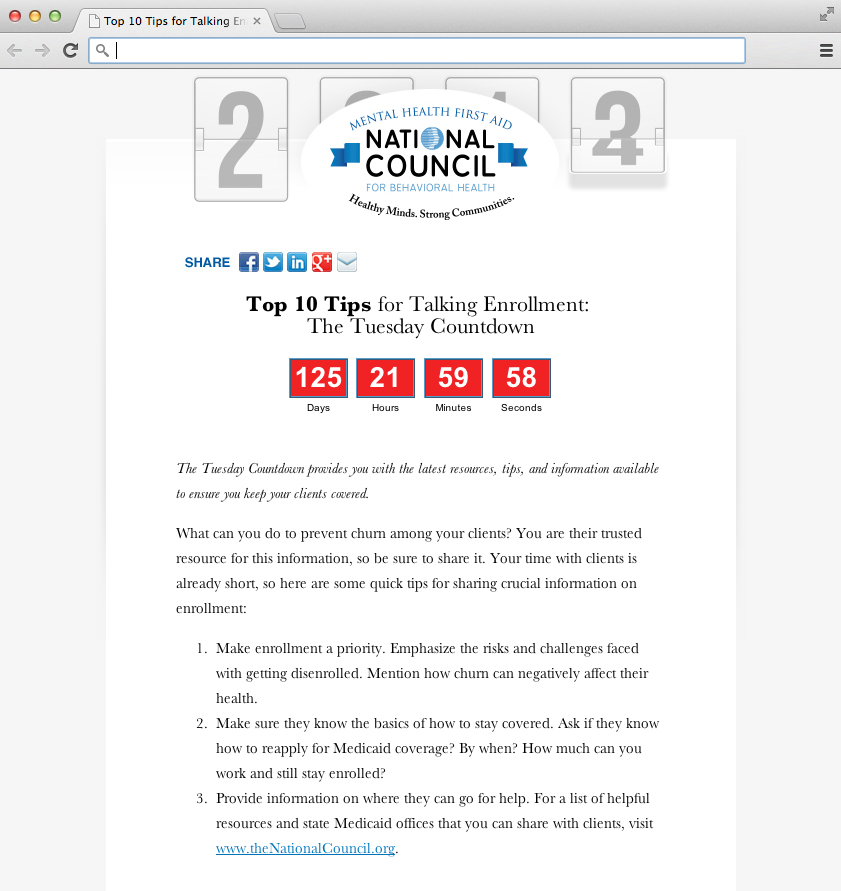
We will ensure great reach and uptake with: • The Tuesday Countdown: A weekly “countdown” email with a live, real-time counter zeroed in on January 1, 2014 (or 11:59:59 p.m., December 31, 2013) that shares the latest resources, tips, and information available from the Centers for Medicaid and Medicare, the National Council, Enroll America, and other groups, as well as tips and communication vehicles our audience can use to reach the people and families they serve (see attached sample image and ‘Rock (en)Rollment InfoGraphics’ below).
We consistently see higher open rates with email marketing and communications sent via email on Tuesday and have selected that day for these emails, accordingly. In addition, December 31 falls on a Tuesday.
• Social Media Saturday: To reach mental health and addiction professionals, advocates, and families engaged with us on Facebook and Twitter, the National Council will schedule a weekly tweet about issues related to churn and enrollment on Saturdays. While most companies enjoy a Monday-Friday workweek, engagement on Twitter and Facebook goes up approximately 17% on weekends. Meanwhile, only about 19% of companies/brands/organizations tweet on weekends. Meaning, we can garner greater engagement with less competition.
The specific social media platforms we will employ in this effort will include: Twitter, Facebook, Pinterest, LinkedIn, and YouTube, as appropriate. All posts will ensure an engaging visual element, as market research shows on platforms like Facebook that the engagement rate can spike 40% by merely including dynamic graphics or photos. Likewise, Pinterest relies on visual content. Twitter, on the other hand, requires brief, compelling information that encourages click-throughs and retweets.
While the information in our tweets, status updates, and pins will be crafted specifically for each platform, the content will relate to the Tuesday Countdown content, thus furthering the reach of the information we share.
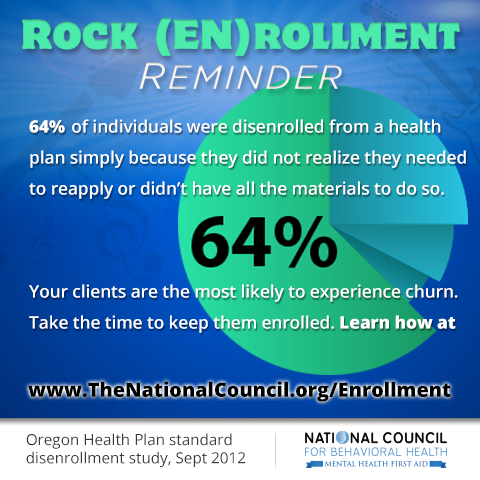
• Rock (en)Rollment Infographics: We will create and disseminate a series of ten simple infographics to share important information about healthcare enrollment for people with mental illnesses. Infographics are some of the most commonly shared content on the internet, with hard-to-match rates of reshares and engagement (Please see attached sample graphic).
• Digital media outreach: The National Council will post the weekly infographic to the National Council homepage, which welcomes 8,000 unique visitors weekly. This will not only ensure the greatest uptake of content, but also ensure that we engage the largest audience through online searches among people who seek information related to enrollment and churning.
In addition to sharing infographics on the website, the National Council will commit a minimum of two blog posts to share the infographics in their entirety and to explore the issue of churn and what providers can do to better protect those they serve through the voice of a thought leader on the topic. The National Council currently maintains five blogs with high engagement levels.
• Webinars: The National Council will host a minimum of two webinars on enrollment in the marketplace and churning, and how providers can help ensure ongoing coverage of those they serve.
• Word of Mouth: National Council staff and leadership are busy travelers, coming and going to national conferences and state meetings. Leading up to and throughout the primary enrollment period, staff will incorporate messaging on preventing churn in their presentations, including where to go for more information on enrollment and resources developed to help providers prevent churn among their clients.
- Demonstration of the potential to improve the health status of individuals with behavioral health needs which will be measured by the likelihood of increased coverage among this population as the result of these efforts. (25 points).
Between 2014 and 2019, an estimated 40 percent of all persons who are uninsured and are newly eligible for Medicaid — or 6.6 million individuals — will have a moderate or serious mental illness. Additionally, 6.8 million uninsured individuals who will gain health coverage through the Exchange will have a mental health diagnosis. Unfortunately, the majority is unaware of the new coverage and services afforded by health reform. Currently 78 percent of uninsured adults and 83 percent of the Medicaid expansion lacks awareness of the new insurance options. This lack of information goes beyond understanding new options, as millions of Americans are currently unaware of how and why to reenroll in healthcare. A 2011 study of disenrollment and churn in the Oregon Health Plan (OHP) found that 64 percent of disenrollment happened because people did not realize they needed to reapply, or they tried to reapply but were unable to provide the required materials.
Research indicates that insurance churn will be a pervasive issue that must be addressed through implementation of the Affordable Care Act. According to Sommers and Rosenbaum (2011), within six months of the date of enrollment, 35 percent of low-income adults will churn between Medicaid and a qualified health plan. Over the course of one year, this number jumps to 50 percent; over four years, 80 percent of all those whose incomes were originally low enough to qualify for Medicaid will eventually lose eligibility. These coverage interruptions can devastate a person’s health and financial stability. Coverage gaps often lead to delayed or complete absence of care and increased and inappropriate use of hospitals and emergency departments.
Uninsured individuals also show worse health outcomes and diminished quality of life compared to their insured counterparts. They are also less likely to receive preventative screenings, treatment for chronic conditions, and have a higher risk of death. The severity of these consequences is only compounded when dealing with mental health or addiction diagnoses, as key treatment components such as prescription drugs, preventative services, and care management are all at risk after a lapse in coverage, placing an individual at increased risk of serious harm.
The National Council, through its bidirectional communication with community behavioral health organizations and families, is ideally suited to help people with mental illnesses and substance use disorders — a population at high risk for churn — to enroll in and maintain health insurance coverage.
Through the use of creative messaging, our extensive community pathways, and pre-existing relationships with key stakeholders around the country, the National Council is committed to improving the health outcomes and well-being of individuals with mental illnesses and substance use disorders, and thus, extremely vested in minimizing risk of health insurance churn.
0 comments